|
|
The Shirt Experiment
Chad Zimmerman © Copyright 2004. All Rights Reserved.
|
|
For years, the location of the holes in President Kennedy's suit jacket and shirt have led many researchers and avid buffs to the immediate conclusion that President Kennedy was assassinated as a result of a conspiracy and the U.S. government, FBI and CIA covered up the truth. This issue acts, for many, as a springboard to that conclusion. However, has any of them ever really researched it? How does one start evaluating this issue?
The basic assumption to the above premise is that the base, or bottom, of a person's shirt collar rests at C6 or C7, or the bottom of the neck. Now, this is a gross assumption based upon the external appearance. The conclusion of the HSCA was that the bullet entered at the anatomical base of the neck, an area that can only be accurately identified through radiographic analysis (x-ray). For many, the location can be palpated in the spine as the most prominent vertebra at the base of the neck. C7 is also referred to as 'vertebra prominens', meaning prominent vertebra. However, variances do exist due to the shape of the spine and the depth of the overlying soft tissues. Again, the only way to know for sure is to x-ray the neck.
Some theorists surmise that the C6-7 area is conclusive because the normal human spine changes it's curvature at the base of the neck, leaving a logical place for the collar to 'sit'. This will be further discussed below.
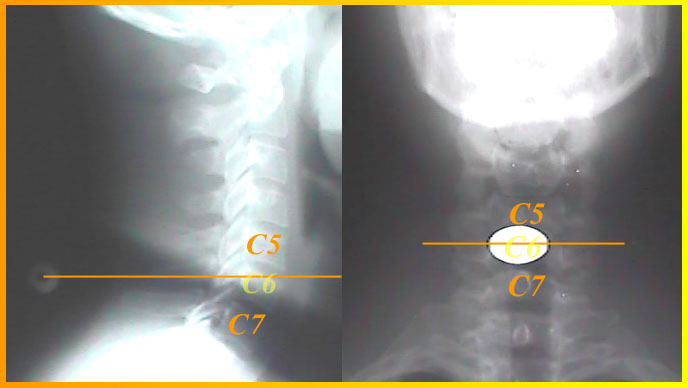
In order to start properly, I palpated the most prominent vertebra in my neck, or upper back. I placed a lead weight on the spot, taped it, and took one AP and one lateral cervicothoracic (CT) x-ray to identify my most prominent vertebra. See below:
|
|
|
|
When I initially saw the result, I thought that my most prominent vertebra was C6. However, you can plainly see that the spinous process of C7 is the most prominent. However, the point palpated lies on a horizontal line with C6, not C7. This helps to illustrate the complications that arise due to the overlying soft tissue, primarily muscle. The interesting point is thus: due to the declination, back to front, of the C7 vertebra, it's spinous process actually lies in the same vertical plane as the C6 vertebra. This occurs so long as the individual has the normal cervical curve, called a lordosis. For anatomical purposes, landmarks relative to the spine are reference by what vertebral body they are in line with and not the spinous process.
Now, the primary question is: What level does the collar really rest at? Of course, please keep in mind that this is on me. However, I am proportionate, as was Kennedy. We'll get a bit more into Kennedy at another time. However, let's continue with the experiment.
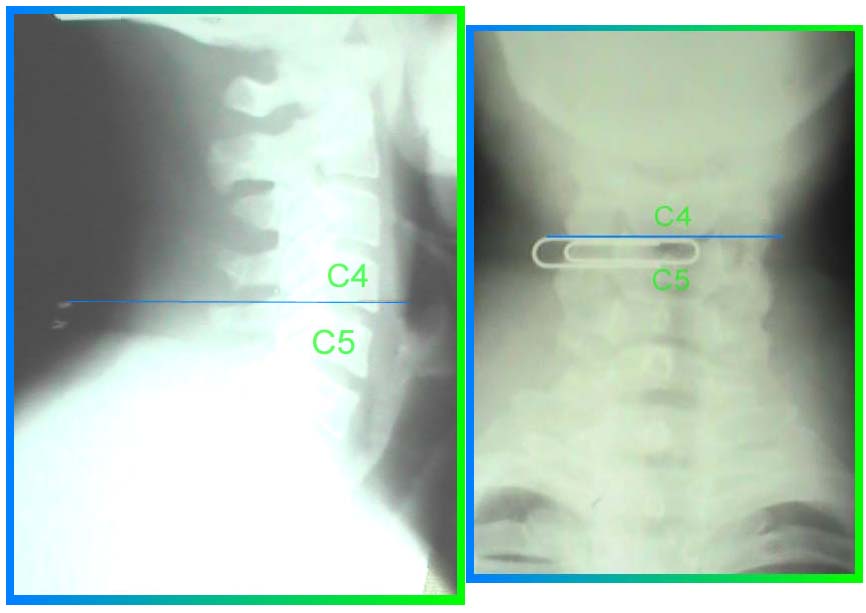
I took a regular, cotton dress shirt and taped a paper clip to the bottom edge of the collar. I took a lateral and AP x-ray to see where the clip rested on a vertebral level. See below:
|
|
|
As you can see, the bottom edge of my collar rests at the C4 vertebral level, using the vertebral body as the indicator. The line in the lateral film does cross part of the upper portion of the C5 spinous process, but is considered the C4 vertebral level. This is in a standing, neutral position and is the natural position for my shirt collar to lay upon. You can see that this is the same point where the curvature of my neck begins in a backward, or posterior direction. It is also the same point where the diameter of my neck beings to significantly increase due to the soft tissue mass of the trapezius muscle. The best indicator to where the collar sits is the circumference of the shirt neck as it relates to the human neck. That does not mean that it sits at C6 or C7.
So, what's the point? Theorists surmise that the 4 inch distance between the bullet holes and the collar would place the wound too far down on Kennedy's back to allow the bullet, traveling downward, to exit the low anterior throat. Hence, the Single Bullet Theory is..."debunked". But is it? Has anyone asked all the questions? I don't know that I have, but I have asked several that haven't been asked before...and I chose to investigate them as any researcher should do before drawing conclusions.
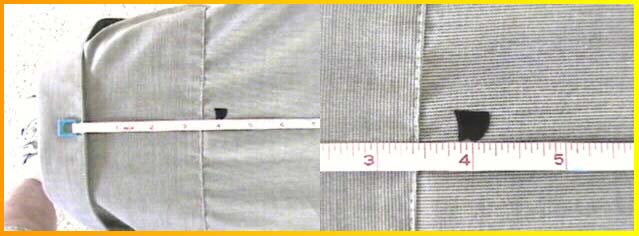
So, what happens when you put a mark on a dress shirt 4 inches below the collar and put it on. Where does the 4 inch mark sit on a vertebral level? I checked this out on myself. First, I placed a mark 4 inches below the collar. See below:
|
|
|
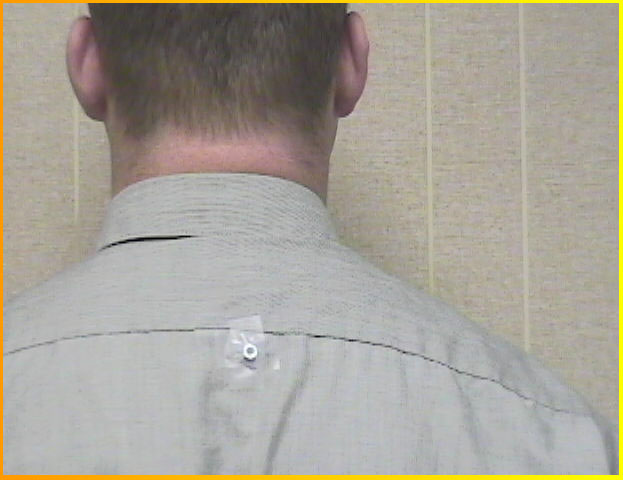
Next, I taped a small, aluminum nut to onto the mark and put the shirt on. See below:
|
|
|
Next, I took an x-ray with me in a neutral position, such as seen above. However, the film taken was an AP, not a PA, with my back...and the nut...to the side of the film. In the photo above, I am facing the film 'bucky' for the purpose of the photograph. Additional photos show my positioning during other portions of the experiment. See below:
|
|
The Neutral AP X-ray
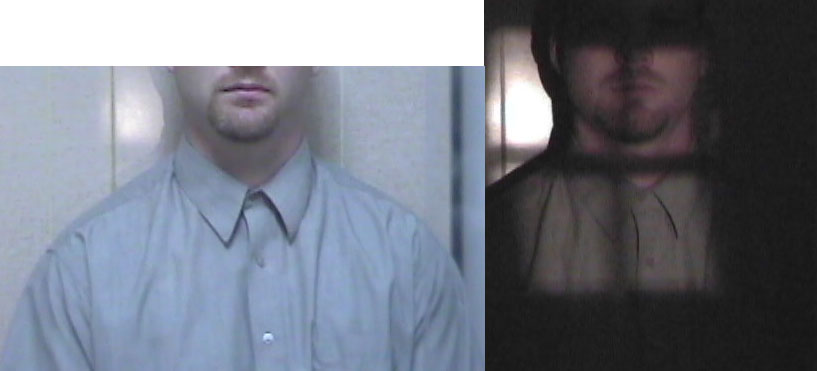
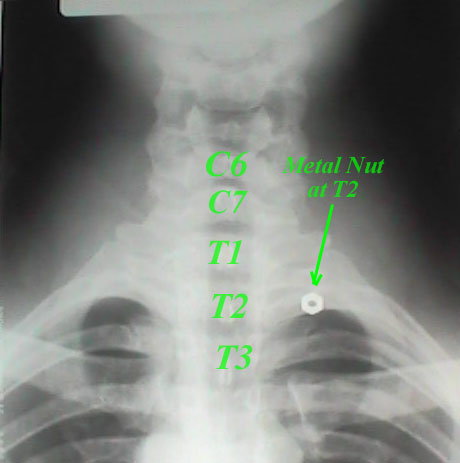
I had the camera remote in my hand, which allowed me to take the picture just before and after the x-ray was exposed. The light is turned off to assure proper alignment during the x-ray taking procedure. See the AP film positioning below and the resultant film.
|
|
|
|
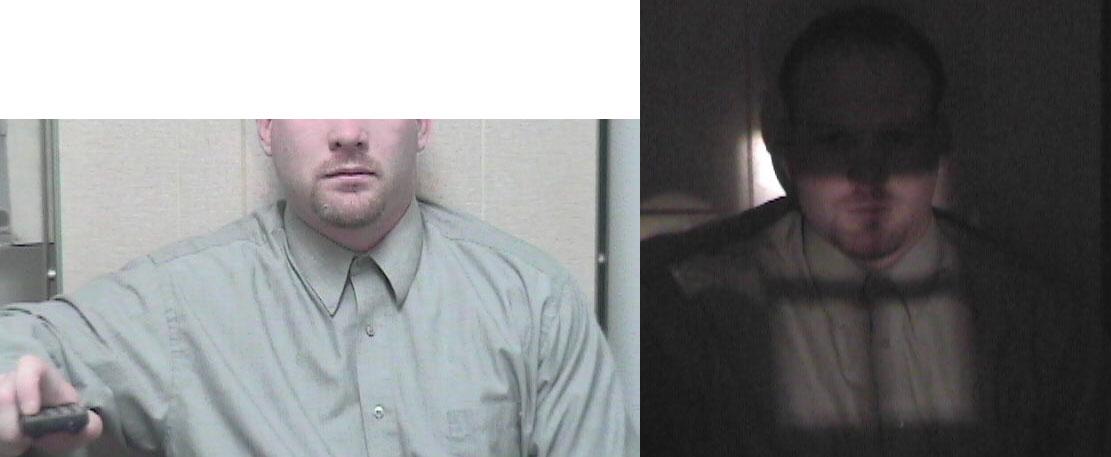
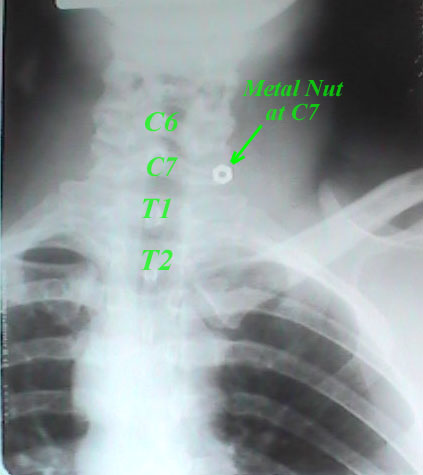
As you can see, the metal nut was precisely at the T2 vertebral level. "Ah-ha", you say? Just wait. I am not in the same position that Kennedy was in. He had his right arm elevated, as it was resting on the car's side, right? I wonder if that little nut would move if I put myself in the same position. Well, let's see. Below you'll find the positioning and x-ray of me with my arm in a similar position.
|
|
|
|
The metal nut is seen at C7, not T1, 2 or 3. Interestingly enough, if you looked closely, my shirt 'bunched' up just below the collar. Why? Simple. When you elevate your shoulders, the fabric lying on top moves, too. The collar is a thicker portion of fabric that is creased and folded down. The shirt fabric, when elevated in such a manner, is 'pushed down' (for a lack of a better phrase) by the collar's bottom edge and a fold of 'bunched' fabric is created. See the following video clip by clicking here. Now, next time you are talking to someone who is wearing a dress shirt and tie or a sport coat, and they are sitting, take note to what the fabric is doing. Chances are that you'll see the 'bunch' phenomenon happen before your very eyes- you just never noticed it before. You can also witness this during just about any movie at Hollywood Video or Blockbuster.
For more on this and its application to President Kennedy, please follow this link.
I hope to have more on this issue at another time.
|