Analyzing the Autopsy Photograph
 
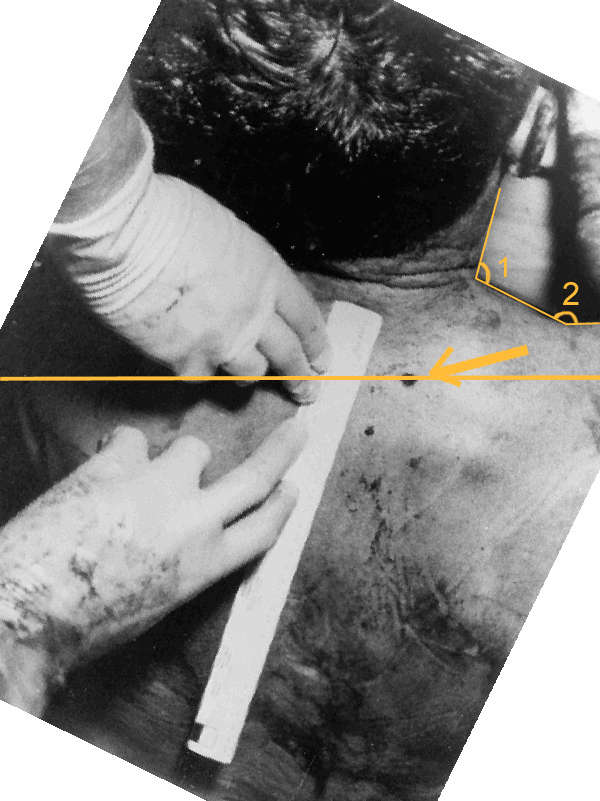
Even those individuals that have a basic knowledge of anatomy are mislead by interpreting the photograph. With just a little research, most theorists find that the acromion process is commonly associated with the level of the first or second thoracic vertebrae (T1-2). The photograph clearly shows President Kennedy's right shoulder above the entrance wound. So, how can the wound be at C7-T1 if the shoulder is clearly above the wound? The answer is easier than the reader may imagine. Muscle physiology.
 
 
One line was drawn horizontally through the wound to show it's relationship to the shoulder in this photograph. The wound is clearly below the level of the shoulder and, hence, below the acromion process. A line is drawn along the lateral portion of the neck, along the lateral border of the trapezius and one along the contour of the shoulder. The most important angle is angle 2. Angle one is formed by slightly rotating the head to the right or a slight lateral tilt to the right, otherwise the neck line would be much closer to vertical. Angle 2 is formed by the contour of the trapezius and the shoulder. It measures about 153 degrees. Therefore, the supplementary angle would be about 27 degrees.  
 
These measurements can provide insight into how Kennedy was positioned at the time of the autopsy photo. The important question in any researcher mind is: 
 
"Could the back wound be at the C7/T1 level (where the WC and HSCA both put it), or is it too far below the acromion to be at that level?
 
We will now examine postural relationships and determine if this is possible.
 
 
Functional Analysis
 
 
Author's note: A small 'dot' of permanent marker was placed on the back at the cervicothoracic junction (C7/T1), slightly right of the spine. This is similar to President Kennedy and will be used as a reference point in relation to the acromion.
 
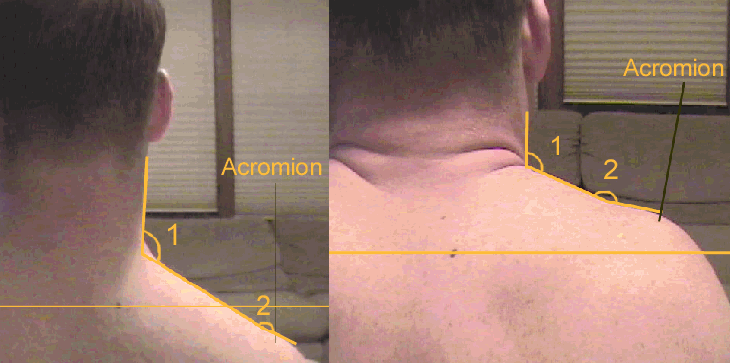
The pictures above show an adult back and are of this author. The first picture is of a back in a neutral position. The right arm is placed at the side, hanging freely. The picture at the was taken after both shoulders are partially flexed (shrugged). The same corresponding angles can be measured. In the first photo, angle 1 (angular measurement between lateral neck and trapezius) measures 119 degrees. Angle 2 (angular measurement from trapezius to superficial acromial contour) measures 171 degrees. The second photo of the partially shrugged shoulder shows the same corresponding angles, however of different measurement. Contraction of the trapezius muscle significantly alters the angles formed. Angle 1 measures 113 degrees and angle 2 measures 167 degrees. This represents and angular change of 6 degrees with angle 1 and 4 degrees with angle 2. These small angular differences create an obvious rising of the acromion above the 'wound' mark. It should be noted that the angular change ALONE is not responsible for the elevation. The trapezius is contracted and most of the elevation occurs due to the contraction of the muscle. Only minimal angular change is noted when looking at the larger angle. However, the percentage difference in the supplemental angle is more pronounced. Nevertheless, the slight change in angulation has a pronounced visual affect.
 
X-ray Evaluation of Mock 'Wound'
 
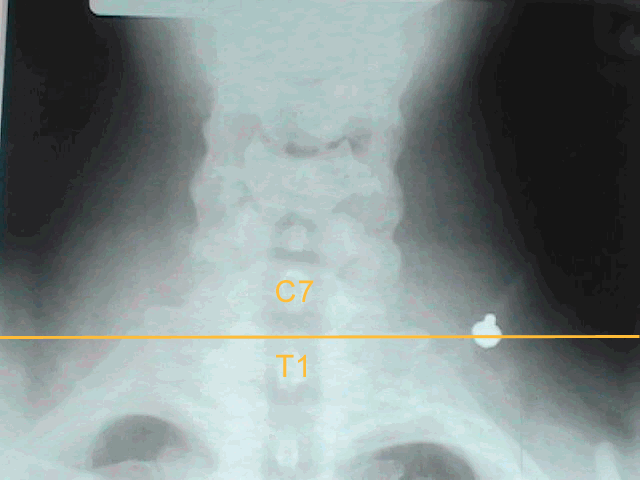
To confirm the mock 'wound' placement, the author taped a small screw to the marked location on the back. An A-P cervical x-ray was obtained to show the correlating spinal region. The spot on the back, as demonstrated by the x-ray, shows it to be at the cervicothoracic junction, or C7/T1. 
 
The reader should note that the screw is to the side of the spine, yet when viewing the picture, it appears to be closer to it. It should be clear that things aren't always as they appear. Kennedy's wound was very likely a bit closer to the spine. This analysis' sole purpose was to illustrate that what 'appears' to be the back may, in fact, not be.
 
 
JFK Wound vs. Mock Wound
 
 
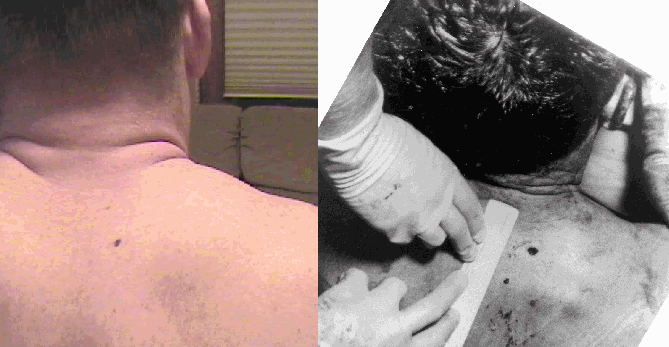
The previous demonstration showed how the eyes can deceive us. Now, compare the autopsy photograph of President Kennedy and the author. The 'spot' on the author is at the C7/T1 level when at a neutral position. The acromion is elevated in both instances, making the appearance of a wound in the upper back. However, in this instance, it is an illusion based on preconception.
 
 
Could President Kennedy's shoulders be elevated in the photograph?
 
The answer is unequivocally 'yes'. The President's autopsy was several hours postmortem. During this time frame, rigor mortis set in. This has been documented in the President's autopsy report. The "Textbook of Medical Physiology, Guyton and Hall, 9th edition" explains rigor mortis as follows: 
 
"Several hours after death, all the muscles of the body go into a state of contracture called rigor mortis; that is, the muscle contracts and becomes rigid even without action potentials. This rigidity is caused by loss of all the ATP, which is required to caused separation of the crossbridges from the actin filaments during the relaxation process. The muscles remain in rigor until the muscle proteins are destroyed, which usually results from autolysis caused by enzymes released from the lysosomes some 15-25 hours later, the process occurring more rapidly at higher temperatures." (page 84-85) 
 
Therefore, the process itself causes muscle contraction. It is this process that, on occasion, causes a corpse to 'move'. In respect to President Kennedy, the contracture of the powerful trapezius muscle would overpower the weaker opposing muscles (muscles that oppose gravity are typically stronger than muscles that do not). This causes a net contraction that would raise the shoulder, elevating the acromion.  
 
In addition, simply moving President Kennedy's body could cause the shoulder to become elevated. However, this author feels that rigor mortis is the more likely contributor.  
 
 
Conclusion
 
Given the study above, the autopsy photograph of President Kennedy's back wound is NOT indicative of a T2 or T3 entrance wound. When all considerations are taken into account, it is shown that the wound could very well be where the Warren Commission and the House Select Committee on Assassinations put it - at C7/T1. Most ill-informed researchers rely on erroneous text or perceptual errors when stating the entrance wound was lower than C7-T1 on the basis of the appearance in the photograph. Even those well trained in medicine can misinterpret the exact level. This is for a simple reason. Surface anatomy is NOT exact. It was designed as a way to estimate the location of an area of interest. However, it was also designed for use in the anatomically neutral position. If part or parts of the body move away from neutral, then the estimation will be erroneous. This author feels that it is more than reasonable for any medical personnel that viewed President Kennedy's body could have erred unless they specifically noted the contracture of the trapezius, which none made any note of other than the general statement regarding the state of rigor mortis.
 
Questions or comments? Email me at doccrz@cableone.net