|
|
"A Critical Analysis of 'What the Blood Tells Us' by Sherry Guiterrez"
Chad R. Zimmerman © Copyright 2002. All rights reserved.
|
|
|
|
(Sherry’s original essay can be found at http://www.jfklancer.com/BloodEvidence.html)
|
|
(Note to the reader: This essay is a response to two articles by Sherry Guiterrez and will be addressed that way. There may be some repetition of points, but the content and supporting evidence being evaluated varies)
|
|
A critical examination of the above-mentioned article, as posted on the JFK Lancer website, reveals that the blood evidence may actually suggest that the shot that fatally wounded President John F. Kennedy originated from the rear. However, to fully understand the implications, we must first dissect the general principles put forth by Sherry Guiterrez and correlate them to the physical evidence.
Sherry Guiterrez provided seven main rules pertaining to blood spatter experiments. They are as follows:
1. The amount of forward spatter (away from the shooter) is greater than the back spatter (towards the shooter).
2. The velocity of the forward spatter is greater than the velocity of the back spatter.
3. Both forward and back spatter forms a ‘cone’ of mist.
4. Both forward and back spatter has a slower velocity than the bullet. Thus, the relationship of the velocities is as such: bullet > forward spatter > back spatter.
5. The density of the fluid droplets formed from an impact to a fluid containing structure decreases as the distance from the bullet impact increases.
6. High velocity wounds to bone may cause bone to go both forward and backward with the spatter (this rule is expanded below).
7. The bullet exits in the direction opposite of the shooter.
Gutierrez uses the available evidence to make a variety of assumptions that prove that the fatal shot to President John Kennedy came from the front. However, close examination of her application of the above observations show flaws in her assumptions.
Guiterrez’s first question to address is how many times was President Kennedy hit in the head. Her conclusion is below.
“Both back and forward spatter are generated from a single projectile creating an entry and exit wound. If blood is observed in front of the President's face, as in witnesses statements and the Z film, and blood, tissue and bone was discovered behind the President, it is appropriate to conclude that one projectile created both patterns.”
Therefore, since only two spatter patterns are evident, only one shot hit President Kennedy. The above statement does not address location of the entrance or exit wounds. However, she does state that blood, bone and tissue were discovered behind the President. This could be consistent with a shot from either direction.
Sherry’s next question was to address the direction of the fatal headshot. Her rationale is as follows below.
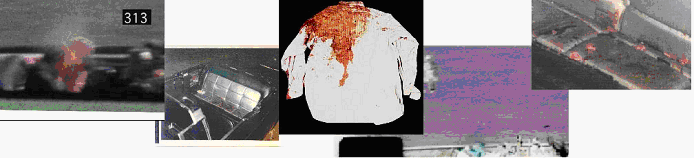
“The physical evidence on the scene documented blood, tissue, and bone to the rear of the President's head. It was found on motorcycle police officer Bobby Hargis, the back of the limousine, and in the roadway. This type of evidence is consistent with forward spatter and an exit wound. Back spatter would have been located in front of the President's head. In the Zapruder film, frames 313 and 314, what appears to be a mist of blood is obscuring the face of the President. This is consistent with back spatter. One of the witnesses, Mr. William Newman described that mist to me as "a cloud of blood." This is a good description of the blood viewed in both the Zapruder film and in Photographs 1-4. Based on statements by witnesses in the death of President Kennedy describing blood spatter they observed, and documentation of blood spatter in the Zapruder film, it is my conviction the head injury to President Kennedy was the result of a single gunshot fired from the right front of the President.
Guiterrez cites the primary evidence as that which was found in the rear of the limousine and on Officer Bobby Hargis riding immediately behind and to the left of the Presidential limo, as well as the Zapruder film and ‘statements by witnesses’. She sites the large mist of blood in front of Kennedy as being consistent with back spatter. In addition, Sherry Gutierrez cites Mr. William Newman. However, digging a little deeper into the physical evidence and other witness testimony can contradict this conclusion. Let’s take a look at the other evidence.
1. Two bullet fragments were found in the front seat of the limousine and weighed 44.6 and 21.0 grains. The FBI found three small lead particles, weighing each between .7 and .9 grains, in the left front jump seat.
2. A small residue of lead was found on the inside of the windshield with small cracks indicating that a bullet fragment hit the windshield on the inside.
3. A dent in the chrome strip surrounding the windshield was found and consistent with being hit from a fragment of the fatal shot.
4. The ‘mist of blood’ could be many things. It may contain blood, bone and brain tissue. It cannot be determined to be only one. This is consistent with either back spatter or forward spatter. When considered in conjunction with the other available physical evidence, one must lean towards forward spatter.
The next question addresses the number of shots to President Kennedy’s head. Sherry concludes that only one shot hit President Kennedy in the head. Her rationale is quoted below.
“Two shots would have resulted in two back spatter and two forward spatter patterns. There is no large amount of blood, tissue and bone discovered in front of the President to support the theory of an entry wound from the back of the head creating a forward spatter pattern in front of the President. It was Bobby Hargis who displayed this blood consistent with forward spatter, not Governor John Connally (he was sprayed with a fine substance like sawdust.).
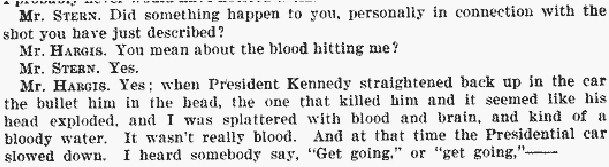
Again, she uses Officer Bobby Hargis’ testimony as primary evidence to indicate the fatal shot came from the front. However, she does expand her evidence here to include the testimony of Governor John Connally who was riding in front of President Kennedy at the time of the fatal shot. However, let’s examine the pertinent testimony. We will first look at Officer Hargis’ testimony.
|
|
|
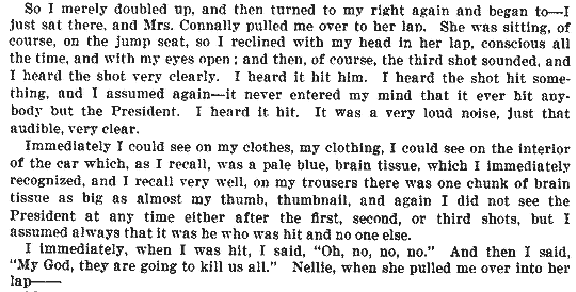
We can see from Officer Hargis’ testimony that he was hit with a mist or fine spray of blood and brain. He said, “It wasn’t really blood”. He referred to it as “bloody water”. This certainly doesn’t describe him being hit with a heavy amount of particulate matter. It sounds like a mist of blood and fine brain matter and certainly doesn’t include “large amount of blood, tissue and bone” that Gutierrez describes as being consistent with forward spatter. Now, let’s take a look at Governor Connally’s testimony. Sherry says he was hit with “a fine substance like sawdust”.
|
|
|
Governor Connally specifically states that he could “see on my clothes, my clothing, I could see on the interior of the car which, as I recall, was a pale blue, brain tissue, which I immediately recognized, and I recall very well, on my trousers there was one chunk of brain tissue as big as almost my thumb, thumbnail”. This is consistent with heavy, particulate matter consistent with forward spatter, as opposed to the ‘bloody water’ that Officer Hargis referred to. Sawdust particles contain solid matter. In addition, the mere fact that Governor Connally could recognize the matter as brain matter suggests that it was not fine particles of brain, but recognizable bits and chunks of brain matter.
Gutierrez’s next point of consideration involves the spatter evidence in the Zapruder film. Specifically, she addresses the lack of both back and forward spatter as seen in the film. She addresses the issue with the following.
“The Zapruder film was recording action 18 frames per second. A regular video tape records at 30 frames per second. The patterns are created, from the first action to the last, in 5 frames. This means the blood droplets are moving faster than they can be captured on the Zapruder film. Two of the Zapruder frames do display high velocity impact spatter that seems to be appropriate when you consider the ratio of the pattern movement and the frame speed of each of the videos.
Remember to consider what was found on the scene, and do not become locked in on the evidence on the Zapruder film as the only bloodstain evidence available for consideration.”
Gutierrez then shows stills and motion video of the Zapruder film to illustrate her point. However, careful examination of the film shows a larger amount of head matter thrown out above and to the front of Kennedy’s skull. As the blood and other matter distances itself from the head, it can be seen slowing down and moving to the rear as the car moves through the cloud of bloody mist. This is completely consistent with a rear headshot when wind resistance is taken into consideration. This would cause the explosive body matter to slow and/or reverse direction due to the small diameter of the blood droplets encountering and external force. The large matter ended up in front of Governor Connally, on his pants and covering the interior of the limousine. In addition, we are to believe that, somehow, two major portions of the fatal bullet ended up in the front seat of the limo by chance. Though she does not specifically say, it is apparent she feels that the forward spatter was traveling too fast to be picked up on the Zapruder film. However, frame 313 shows the nearly exact time that Kennedy’s head exploded and the majority of the wound spatter is thrown forward. A significant amount of the forward spatter can be seen creating a cloud of fine mist that gives the appearance of moving to the rear since the car was moving forward. No doubt, some of this ended up on the trunk and may have contributed to the “bloody water” that Hargis remembered being sprayed with. This, again, is consistent with a rear shot.
The biggest problem surrounding Gutierrez’s analysis is her lack of incorporating all of the factors. Her analysis is based upon selective testimony and the blood spatter evidence from a .45 caliber slug traversing through the center of a blood-soaked, soft sponge and applying the analysis to a moving hard target with some amount of wind resistance. In addition, the .45 caliber slug was traveling in a nearly perfect horizontal trajectory at less than 50% of the Carcano 160 grain bullet’s velocity that hit in the upper half of the skull. When the remaining factors are considered, the evidence cited in Gutierrez’s analysis shows that the fatal shot came from the rear, as all commission inquiries have found.
Additional Analysis and Considerations Based on “Bloodstain Pattern Analysis and the Kennedy Assassination” by Sherry Guiterrez
Sherry Guiterrez does a good job at citing the principle physical properties affecting blood spatter patterns due to gunshot wounds. Since initially writing this paper, I found a larger, expanded essay of Sherry Guiterrez’s on the JFK Lancer website. The basic principles governing blood spatter pattern analysis are undisputed and as follows. Any reader should consult the original document found at http://www.jfklancerforum.com/sherryg/
1. In every instance during the experimental shooting of bloody targets, regardless of projectile velocity or blood volume, blood was disbursed back toward the shooter and propelled forward in the continued direction of travel of the projectile. This made comparisons of the two patterns created from a single incident possible.
2. Frequently, fragments of the bloody sponge permeated the forward spatter pattern. Occasionally, sponge fragments were observed in backspatter. Fragments located in the back spatter were consistently minute in nature; however, the fragments in the forward spatter varied in size and were occasionally large.
3. Forward spatter traveled farther than back spatter created in the same incident.
4. Forward spatter held a larger volume of blood, expressed as individual stains, when compared to back spatter created in the same incident.
5. On both forward and back spatter targets the stains near the center of the pattern were circular in shape, as a result of striking the target surface at or near a 90-degree angle.
6. At the perimeters of both forward and back spatter patterns the stains were more elliptically shaped as a result of the stains striking the target at an angle.
7. The distribution of the droplets was more concentrated when the target surface was near the bloody target, with the distance between the droplets increasing as the droplets moved away from the bloody target.
8. Increased volume resulted in increased pattern dimensions.
9. Forward and back spatter targets displayed a multitude of minuscule blood droplets, some resembling an atomized spray or mist. The majority of the stains had an average diameter of .10mm or less.
10. In video-captured incidents the target moved dramatically with the direction of the force (the projectile) upon impact. Normally this larger, more pronounced movement traveling with the projectile followed a smaller movement to the front upon impact.
11. The videotape used to capture patterns as they were created records 30 frames per second. The video utilized approximately 4-5 frames to capture the forceful impact pattern when a low velocity, large caliber projectile with a high KE rate impacted a large volume of blood. This means that particular pattern was created in its entirety in 1/6 of a second. Some patterns were created in less than 1/6 of a second.
Note: The video camera used to capture the shooting sequences captured frames at a rate of 30 frames per second. The blood spatter was created in 4-5 frames with a low velocity, large caliber projectile. In short, the pattern was created in 1/6th of a second, or the equivalent of 3 Zapruder frames.
Sherry makes a key point in her article that cannot be overlooked. She states, “Larger fragments of the target were found only in the forward spatter.” (emphasis added)
Sherry’s basic principles are correct. However, the application of the principles to the situation and physical evidence is in err. In support of the frontal head shot theory, Sherry cites the testimony of Robert Frazier:
“"We found blood and tissue all over the outside areas of the vehicle from the hood ornament, over the complete area of the hood, on the outside of the windshield, also on the inside surface of the windshield, and all over the entire exterior portion of the car, that is, the side rails down both sides of the car, and of course considerable quantities inside the car and on the trunk lid area." (31) (Added emphasis)”
She continues to apply some form of rationale to the above by saying, “(T)his seems to indicate Frazier believed the greater volume of blood and tissue was located inside and on the trunk of the vehicle (32). A large volume of the blood and tissue inside the vehicle is documented in photographs; no photographs of the blood located on the vehicle exterior have been documented.”
However, let’s try and quantify Frazier’s quotation. First, he mentions the hood ornament, over the complete area of the hood, the outside and inside of the windshield and the side rails on both sides of the car. These are all in front of Kennedy’s position in the car. He mentions “considerable quantities” inside the car, followed by a mention of the trunk lid. His quotation contains 73 total words with 3 of them (trunk lid area) being the only mention to the rear of Kennedy exclusively. All other areas are to the side and/or front of President Kennedy’s position in the vehicle. Now, please remember that the limousine was moving forward at the time of the fatal headshot. Given this motion, any material ejected forward would be found to the rear (or short) of the normal landing position if the car were stationary. Any material thrown to the rear would’ve landed at a point further to the rear than in a stationary situation. Given this, it would seem that Sherry’s position on Frazier’s testimony is a little slanted.
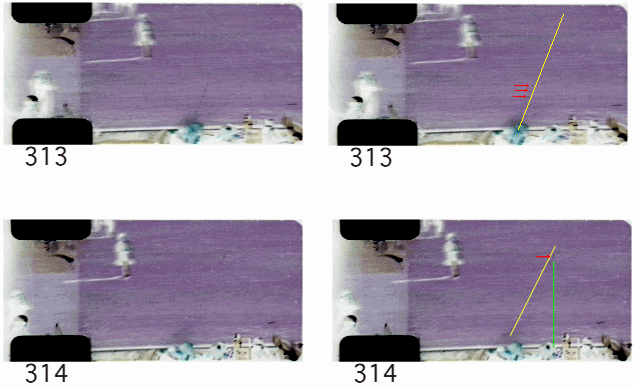
Sherry even mentions the white streak of ejected head matter seen in the Zapruder film. What she makes no mention of, is that by frame 314 this piece of bone or brain is at a position slightly in front of Governor Connally. Obviously, this large piece of ejecta contains a substantial mass. It is the most prominent piece of matter ejected as visualized by the Zapruder film. Since the rules of blood spatter state that large portions of target matter are only found on forward spatter, this would indicate that the ejecta in question is part of forward spatter, hence a rear headshot. In fact, the vast majority of all ejecta is seen to move in front of Kennedy. Then, the blood cloud slows and forms a mist as it slows down and appears to move to the rear since the limousine is moving forward. Sherry notes that this piece of ejecta may be the infamous Harper fragment, a fragment of Kennedy’s skull that was found at a location that would be in front of where Kennedy was shot in the head.
Sherry states,” When comparing the spatter described by those behind the limo, to those within the limo, it appears larger volume of blood was observed behind the President (33)”. However, when the reference is checked it quotes the following testimony:
“33. " ...it was like a bucket of blood was thrown from his head" -Bobby Hargis
"My eyes saw bloody matter in tiny bits all over the car." -Nellie Connally"It was like a red mist or a cloud of blood in front of his face" -Bill Newman
Apparently, Sherry doesn’t feel that Nellie Connally’s reference to “tiny bits” is consistent with front spatter as well as back spatter. One can speculate on what the “bits” were of. Nor does she realize that “red mist or cloud of blood” is consistent with forward and back spatter. Of course, you have to remember the bone, bullets, blood and brain that were found in front of Kennedy that are completely disregarded and consistent with forward head spatter and a rear headshot.
|
|
|
Zapruder frames 313 and 314- these frames were created into negatives using Adobe Photo Deluxe Home Edition 3.0 to show enhancement of the ejecta following the bursting of the skull due to the massive pressure generated by the forming of a pressure cavity in response to a high velocity projectile. These negative images show the direction of the spatter containing large portions of brain and/or bone matter. The bottom frames are illustrated to show the path of the ejecta and arrows indicate some of the large portions of matter ejected that can be readily seen in the still frames of the Zapruder film. The yellow lines indicating the trajectory of the ejecta are drawn just to the right of the ejecta to prevent obscuring the focus of the illustration. The vertical green line is drawn straight down from the highest fragment seen. It is clearly in front of Governor John Connally’s position in the car. According to the precedent set forth by Guiterrez, this cannot be back spatter as it is clearly not fine mist of fine fragments of bone or brain.
|
|
The most significant factor that is not addressed by shooting blood soaked sponges with a projectile is the manner in which President Kennedy’s head exploded upon impact. The pressure cavity caused a large portion of the right lateral portion of his head to open up so the pressure could be released. This mechanism causes a blending effect of the ejecta making determination of the entrance and exit wounds more difficult due to the approximation of the two wounds by the explosion of the skull. This obscures the normal cone of ejecta by bringing the two spatter patterns very close together, yet the basic premise still applies- more ejecta is thrown in the direction of the projectile than towards the origin of the shot. This is easily visualized in the above frames.
Conclusion
While this author is in complete agreement with the basic principles of controlled blood spatter experimentation, I cannot agree with Sherry Guiterrez’s conclusions. Scientific analysis and conclusion cannot be made without evaluating the available physical evidence. The evidence is as follows:
1. Two bullet fragments were found in the front seat of the limousine and weighed 44.6 and 21.0 grains. The FBI found three small lead particles, weighing each between .7 and .9 grains, in the left front jump seat.
2. A small residue of lead was found on the inside of the windshield with small cracks indicating that a bullet fragment hit the windshield on the inside.
3. A dent in the chrome strip surrounding the windshield was found and consistent with being hit from a fragment of the fatal shot.
4. The location of the recovery of the Harper fragment is well in front of the location on Elm St. where Kennedy was hit in the head.
5. The film evidence shows a large streak of brain or bone matter clearly forward of the location where Kennedy was shot in the head.
6. The witnesses that were behind Kennedy described a bloody mist consistent with either front or back spatter. None described large portions of bone or brain.
7. Governor Connally remembers being sprayed with particulate matter containing fairly large portions of brain tissue, bone and blood. This is consistent with forward splatter and not back spatter.
8. The moving limousine was found to have large amounts of blood and matter throughout the interior, both sides of the windshield and on the hood of the car. This represents a lot of blood and matter in a forward direction. Some of the forward spatter formed a mist that the rear portion of the car and the motorcycles drove through, creating some of the blood and matter evidence visualized and testified to.
9. No bullet fragments were ever recovered at a position to the rear of President Kennedy.
While the appearance of the wound differs greatly from a .45 caliber bullet traversing a blood-soaked sponge, the basic principles are correct. Sherry Guiterrez has not addressed all of the evidence and continues to misconstrue testimony with a high degree of selectivity and interpret evidence to promote a frontal headshot theory. This may be summed up with an opening statement that is on the JFK Lancer website describing how she became interested in evaluating the Kennedy assassination. It reads:
“In 1994 my sister (Debra Conway for those of you who know her) and my husband, Carlos were sitting at our kitchen table discussing the photographs of the Zapruder film in a book she was reading. They began to talk about the blood in frame 313 and something they said caught my attention. I went over to them and looked at what I immediately believed to be blood spatter. Since the previous conversation had suddenly become one centered on my professional life, I began to listen in earnest. Subsequently, I discovered I knew something that was not common knowledge to the "Kennedy Buffs" in my family; the frame they were looking could be used to physically show the headshot was from the front. After much conversation, sketching, dragging out police casework photos and my bloodstain pattern research material, Debby began her push for me to do a serious study and publish my findings.” (emphasis added)
As we now know, Sherry Guiterrez is the sister of Debra Conway, who operates the JFK Lancer website and is a staunch conspiracy believer. And, as described in her own words, she approached the project with a predetermined conclusion that the fatal headshot was fired from the front. However, the evidence is contradictory to the predetermined hypothesis.
|
|
Sherry Guiterrez has responded to this page with a rebuttal pertaining to most issues involved in this paper. Click Here to see the rebuttal article.
|
|
My response to her rebuttal is now available. Click Here to view my response.
|