|
|
"Back and to the Left, Back and to the Left"
Chad R. Zimmerman © Copyright 2003. All rights reserved.
|
|
|
|
The above image is severely disturbing to all that view it. To most, it is proof positive that the fatal bullet that hit President Kennedy came from the front. Otherwise, how could Kennedy's head snap violently 'back and to the left'?
|
|
Since it's very first public broadcast in 1975, the image of President Kennedy being shot in the head has transfixed opinion within the cortex of almost every viewer. I can remember seeing this for the first time while watching Oliver Stone's 'JFK' in the early 1990's. Kevin Costner's repetitive "back and to the left" had convinced me that the bullet must've hit Kennedy in the front of the head. We all know that when a bullet hits a dense target, the target moves away from the bullet....Right? We see it in Hollywood all the time.
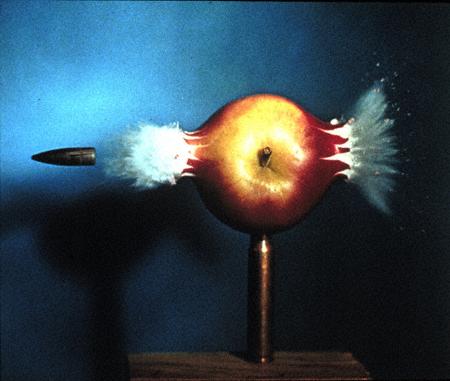
Some of the above assumption is true. If you were to take a block of wood and shoot it with a rifle, it would move away from you...just as you'd expect. However, when a bullet hits a target that is significantly less dense, such as a body or head filled with brain and blood, it is a little different. In order for a bullet to move it's target, a significant amount of the bullet's energy must be transferred to the target. If the target is dense and cannot 'give' , the target will absorb the energy and move away from the shooter. If the target is less dense, such as an apple, the bullet may only push the apple a small distance. If the caliber is small enough and fast enough, the bullet may not even motion visible to the naked eye.
|
|
|
|
A bullet passing through the center of an apple. Any movement is reduced due to the lesser density of the apple. Shooting a block of wood would be dramatically different.
|
|
The human body and head represent combinations of dense bone and lighter density soft tissue. Therefore, we are not dealing with a 'cut and dried' case. A shot to the head would cause a significant reduction in velocity of the bullet when the bullet initially contacts and penetrates the dense skull. This expenditure of energy to a skull causes a diffuse fracturing of the bone away from the impact site. The bullet often fragments into many portions, some small and some large. Those fragments still possess a lot of energy. They transit through the soft brain tissue creating a 'pressure cavity' as the energy that is lost builds up. The fragments that contain enough mass and velocity impact the bone. Only those with enough energy penetrate the dense bone, causing more fracturing of bone, leaving a larger exit diameter. The pressure cavity that has built up is released through the area of least resistance, most often the exit wound. This is the expulsion of the pressure takes soft tissue and bone with it, as it has absorbed some of the energy that was lost by the bullet as it passed through. Sometimes, due to the diffuse fracturing of the skull bone, the exit wound may encompass a large area all the way back to the site of entry. However, typically the vast majority of the ejected material is through the area where the bullet exited. The expulsion of the tissue creates a phenomenon known as the 'jet effect'. Basically, the ejected material produces a 'recoil' effect to the target material that 'pushes' the target towards the shooter. Not convinced? Neither was I. I had to try it for myself.
I decided, as I often do, to conduct an experiment. I obtained an 8-pound turkey breast. I took a rack of adult pork ribs and cut it in half. Using the plastic netting around the turkey breast, I inserted the rib bones onto one side of the turkey breast. I wanted to see what would happen if I shot it with full metal jacketed 6.5mm ammunition. I hung the 'ribbed turkey breast' from a hook and stepped back to a safe distance. I had set up my video camera to tape the impact. I took aim at the rib bone, hoping to hit the rib, and squeezed the trigger of my Carcano. The following clips is what ensued.
|
|
|
|
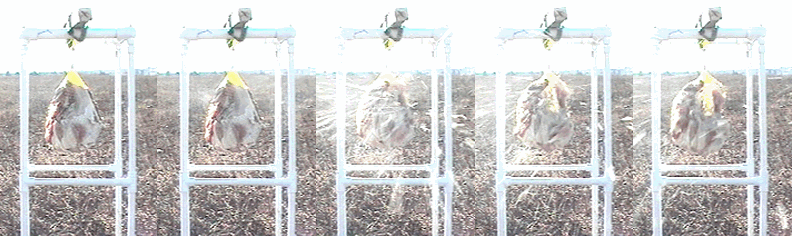
The clip above shows a 139 grain FMJ 6.5mm round hitting the 'ribbed turkey breast'. In slow motion, the bullet enters and exits with only a small amount of tissue spatter. After the bullet exits, the pressure cavity releases and explodes to the right. This causes the 'jet effect' and 'pushes' the ribbed turkey back towards the shooter (to the left). Here is the sequence in slow motion.
|
|
|
The second frame shows the entrance and exit of the bullet. The turkey breast has not moved. The remaining frames show the explosion of the soft tissue, pushing the turkey breast towards the left, or towards the shooter.
|
|
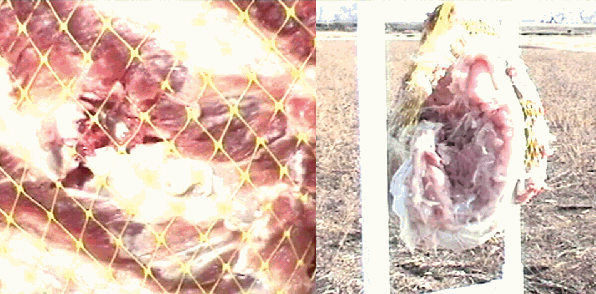
As the picture sequence shows, the bullet traverses the entire ribbed turkey. The third frame shows the expansion and explosion of tissue that occurs as the pressure cavity 'releases'. By looking at the left border of the white PVC 'hanging rack', You can see that the first observed motion is towards the shooter, not away. This bullet hit the top portion of a rib bone before going through the turkey. This creates more dispersal of energy and a more forceful pressure cavity explosion. See the damage to the 'ribbed turkey' below. Click here for a video showing what happens when a rib is NOT hit.
|
|
|
The white portion of the picture to the left is the rib bone. The rib fractured completely. The opposing picture is from the rear of the turkey breast. You can see the explosive damage created by a 139 grain full metal jacket 6.5mm Carcano round.
|
|
Hopefully, this illustration of my experiments has shown that Hollywood isn't always the best history teacher. Real ballistics is much different than we are shown in the dramatizations of the 'Big Screen'. However, this does create another key question. Why did Kennedy's head snap back like it did if it wasn't caused by a bullet? The other prevailing theory is that of a neurological spasm, but that is for a different discussion to be posted at a later date.
|