|
|
"Vertigo, Meniere's Disease and other Disorientations: Unraveling the F8 Photo"
Chad R. Zimmerman © Copyright 2003. All rights reserved.
|
|
|
|
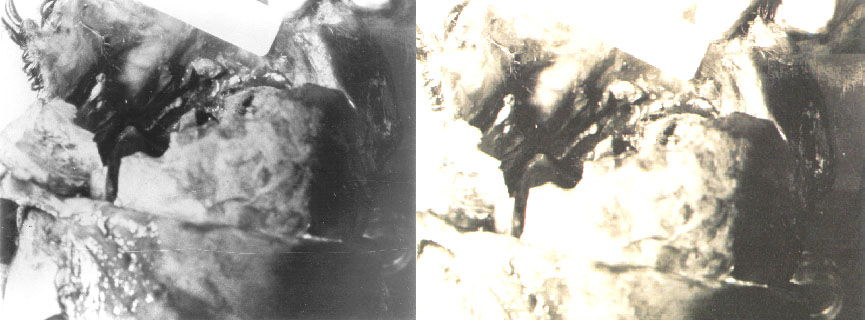
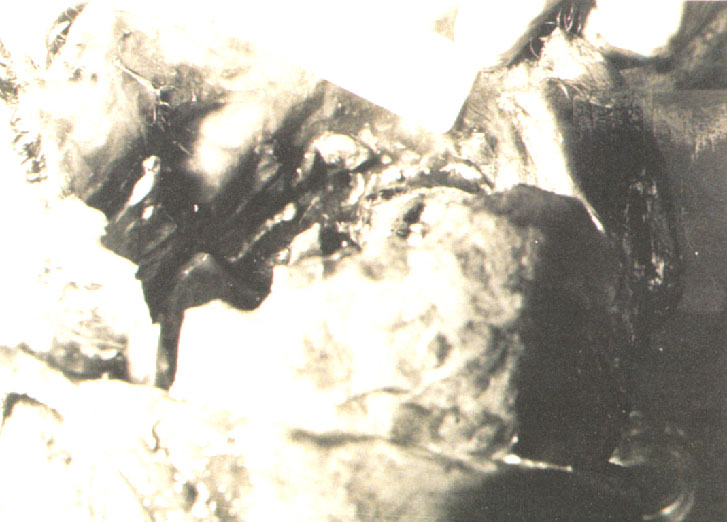
The first image is a scan from David Lifton's 'Best Evidence'. The second image is scanned from Robert Groden's 'The Killing of a President'. They show the alleged 'back of the head' photograph. However, these photos are rotated 90 degrees to show the 'front of the head' orientation possibility. This author feels that these photographs show the front of President Kennedy's head for reasons to be discussed below.
|
|
The question of the location of the wound in Kennedy's skull is paramount to making a conclusion regarding the issue of conspiracy. Several autopsy photographs exist and one would think that these would conclusively answer the questions. However, due to poor procedure, the most revealing photograph- known as F8 (pictured above)- has done nothing but create questions. Mainly, how does one orient the picture since it does not contain known landmarks? First, take a look at the typical conspiratorial orientation.
|
|
|
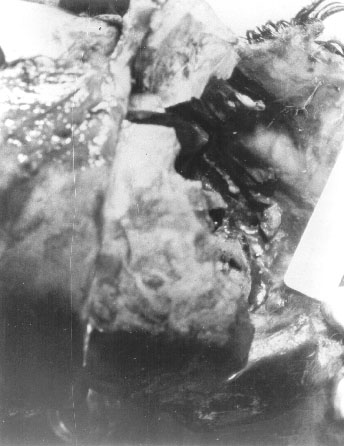
According to many conspiracy researchers, this is the correct orientation of the F8 photograph- showing the back of President Kennedy's head. This photo shows the alleged rear exit wound (the semi-circular defect just above the center of the photo). Many go as far as to say that some of the wrinkles in the neck can be seen. To many who view the picture this way, it is proof positive of a conspiracy as it shows evidence of a frontal entrance wound and the resulting rear exit wound. Are they right? Let's look at some interesting areas in the photograph. The first area is located in the bottom left aspect, followed by the middle and bottom right regions. See picture below.
|
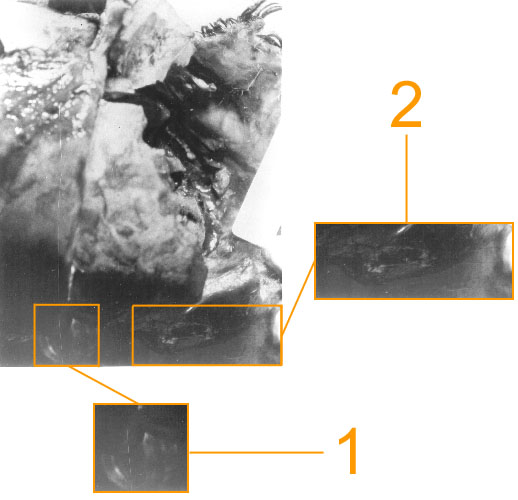 |
Area 1 has been the focus of numerous research efforts. The highlighted area looks very much like a jar lying on its side. Most researchers agree that this is a jar. It's purpose is unknown. Some have speculated that the jar had a fixative agent, such as formaldehyde, for preservation of tissue samples. However, we may likely never know for sure if it is in fact a jar and what it's purpose may have been. However, IF it is a jar....why is it on it's side? And, most importantly, why can it be seen? Shouldn't the left side of President Kennedy's neck be there? In order for this to conform to a 'back of the head' orientation, the head must be significantly rotated.
Area 2 is much more complex of a region to 'dissect'. First, there is a nice contrast between what has been called the lower skull and the neck. Secondly, conspiracy theorists say they 'see' horizontal lines that are wrinkles or creases in Kennedy's neck. But, if this were true, then the scalp was reflected from right to left across the back of the skull. Notice the fold created by this. It is almost perfectly straight. This can only happen if the skin at the base of the head is cut to free it up. Otherwise, you end up with a diagonal crease because it is still attached laterally to the right side of the skull and neck.
|
|
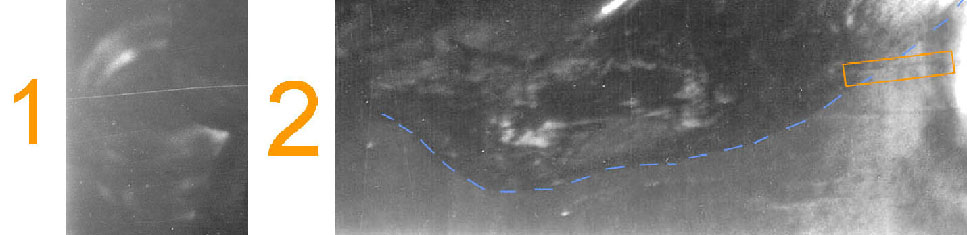
Please see the blown up portions below. I have lightened the clipped portion of the photograph to enhance the detail in this dark region of the photograph.
|
|
|
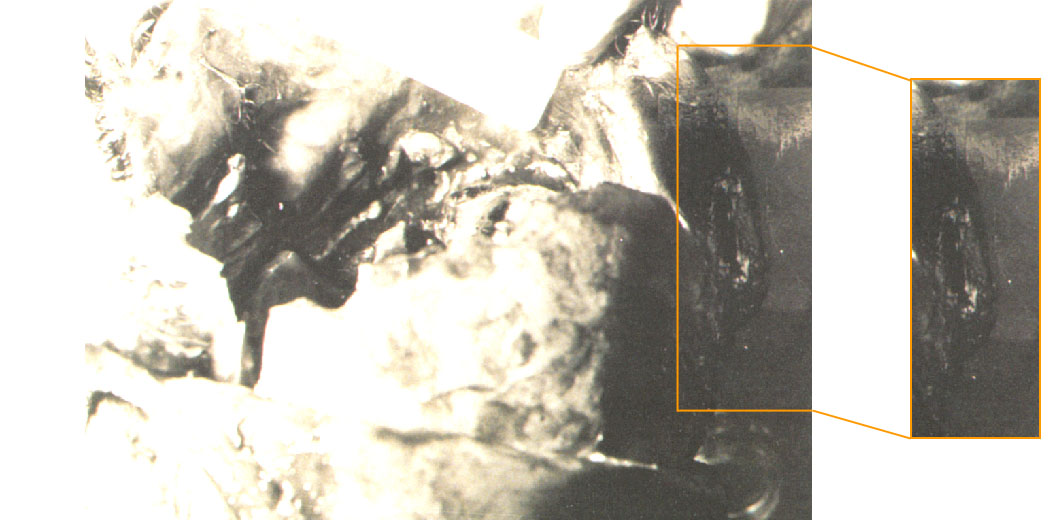
The first image is rotated 90 degrees to the right to help with the visualization of the 'jar'. The darkness on the right edge is caused by bone and folded scalp. The second picture is highlighted to show one of the alleged neck creases (within orange square) and the edge of the skull.
|
|
Let's examine the latter of the two images. The first image is self explanatory and is described in the box caption above. The second image deserves considerable explanation. First, the alleged neck crease. The blue dashed line shows the edge of the skull after retraction of the scalp. The alleged crease runs from what is supposed to be the right side of the neck, or right lateral neckline. It runs slightly diagonally top to bottom, right to left. Now, note the characteristics of this alleged crease. It actually runs into the margin of the skull...but the scalp has been reflected. Hence, there is not any skin there and it cannot be scalp. Also, please note the contrast between the edge of the scalp and the 'shades of gray' region below. The skull has a much more detailed resolution than the cloudy gray below. Since the neck is attached to the skull, one would expect similar resolution to the alleged neck region. However, we don't see that because it is not the neck. If you view the entire image, you can see this phenomenon 2 other times just above the highlighted area. I will explain this further. Now, let's rotate the entire picture as if it were the 'front of the head'.
|
|
|
This photo was scanned from Robert Groden's 'The Killing of a President'. It shows the detail in the picture somewhat better. The most interesting area. This is in the previous area that had been referred to as the 'right lateral neckline'. This area helps to answer whether or not it is really the neck. The first area to note is highlighted below in a cropped photo of the above picture.
|
|
|
This cropped area is very compelling. It contains the key to the orientation of the picture. There are two distict 'lines' noticed in this cropping. In addition, they are parallel. See below.
|
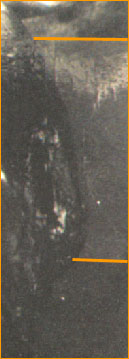 |
As you can see, there are two distinctly defined borders, or lines. Between the lines is an area that is 'less gray' than the area above and below. Since this area is so well delineated, it must be some defined structure. It cannot be the neck for several reasons. First, it is entirely too narrow when compared to the total left to right dimension of the head. If it were the neck, President Kennedy would've looked like a second grade 'stick' person.
Second, if this is the back of the head as most conspiracy researchers would like you to believe, where is the neck? There is a sharp contrast between the skull and the 'neck' area. This implies that the 'neck' area is distanced significantly from the skull. If it were the neck, then we should easily see the muscles that attach to the base of this skull. These muscles would create less contrast between the neck and skull. However, you cannot see anything that resembles the neck. You see a skull without any muscles attached, two suspiciously un-necklike lines with a lighter gray area between them. Then, you see a very dark area and the 'jar'. Absolutely nothing resembles the neck in this photograph. So, what is between the lines? Let's take a guess.
|
|
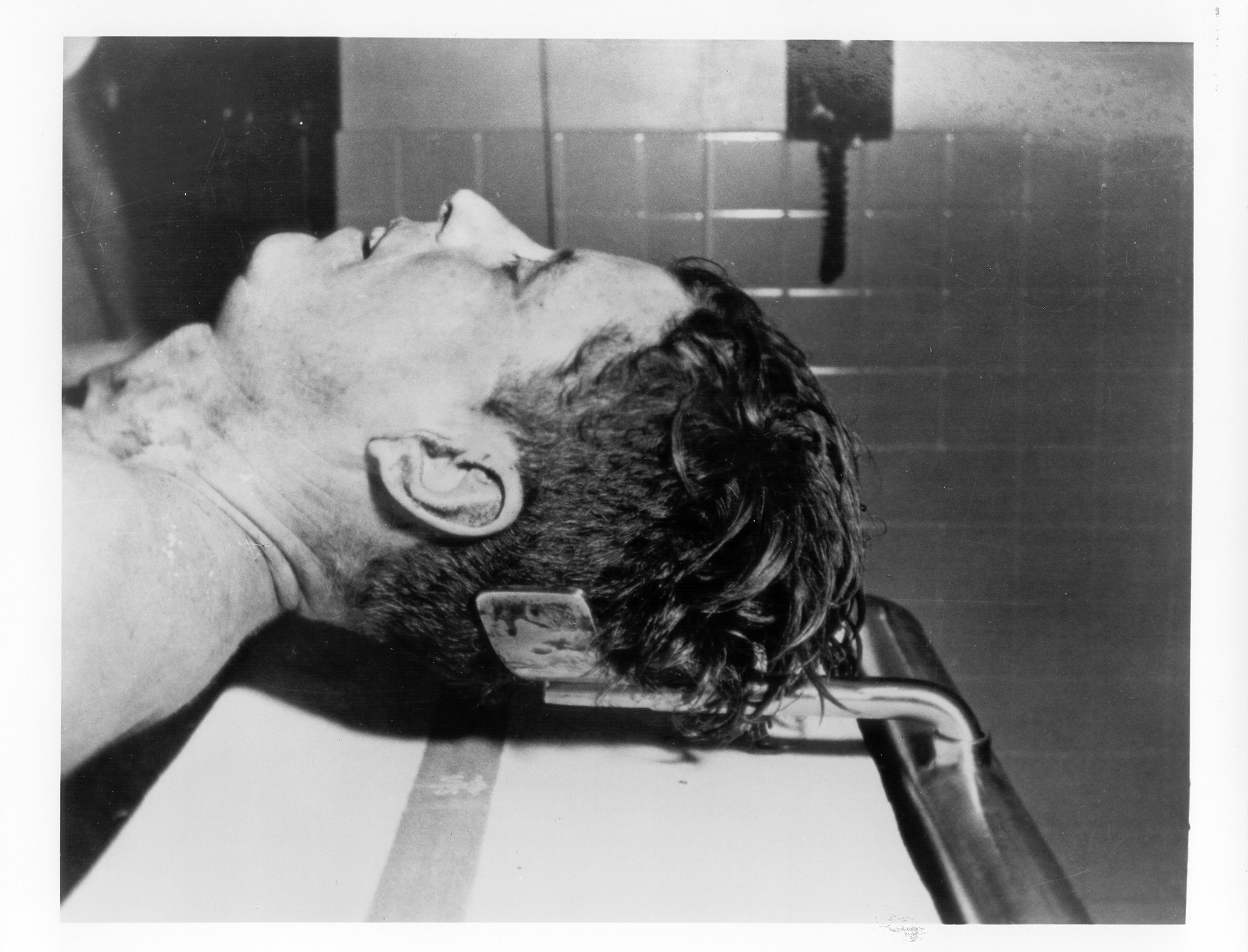
First, let's look at the surrounding area, mostly the autopsy room itself. It has a floor. It has walls. It has tile that go part way up the wall. Let's look.
|
|
|
As you can see, there is tile on the wall. I only goes up part way, creating an obvious margin on the wall that would be reflected in the back ground of a photograph.
|
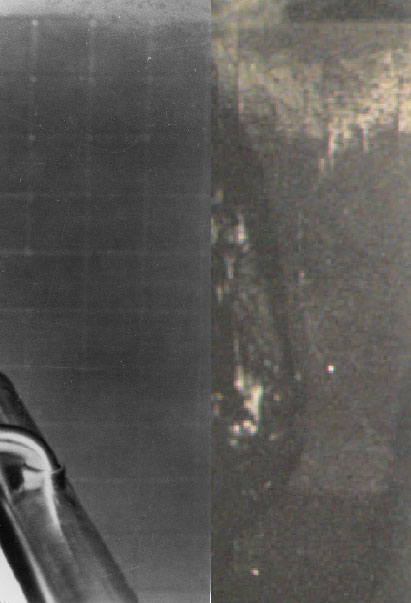 |
Here is a comparison of the two photographs. The left half of the picture is a cropping from the left profile autopsy photograph as pictured above. The right half is a cropping from Groden's F8 photograph of the alleged 'tile wall'. As you can see, there appears to be a geometrical pattern to the wall on the right that is consistent with the tile on the left. Of course, the tile on the left is closer to the camera than the tile on the right. The 'wall' on the right appears to have some of the floor in it- right where the tile stops, in the area where the mid-neck is supposed to be.
Now, there is one part of the right hand cropping that is puzzling. There is a white, uneven, almost cloudy area at the top. This area continues into the skull area and is responsible for some of the misinterpreted 'neck creases'. But, what is it? I have to admit, I don't know. But, it does appear to be somewhat 'fluid' in nature. That is, it appears, to me at least, that there is some type of chemical damage- either to the print or the negative -that creates this bizarre appearance. It creates almost an image that is almost reflective in nature. This can only be confirmed or denied by the viewing of the original print and/or negative.
|
|
So, given the above findings, this author feels that this picture can only be taken from the front due to simple anatomical considerations. This would explain many of the mysteries outlined above.
|
|
Back from the Archives- Page 2
|