|
|
|
|
Chad Zimmerman © Copyright 2004. All Rights Reserved.
|
|
Italian Military (SMI) vs. Western Cartridge Co. (WCC) 6.5mm Carcano Ammunition
|
|
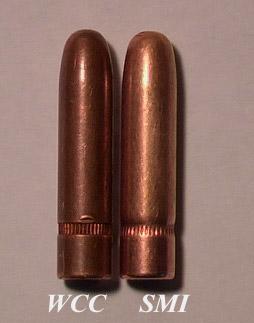
As questions continue to persist regarding the details surrounding President Kennedy's wounds remain, continued studies are required to help answer the 'How' questions that remain. Since I own an identical 6.5mm Italian Carcano with scope, I need ammunition that is ballistically identical in order to produce valid data applicable to this case. The Western Cartridge Co.of East Alton, Illinois produced four million rounds of 6.5mm ammunition in 1954. The rounds were released on the U.S. market a few years later, along with the Italian military rifles. The WCC ammunition has become quite rare in recent years. I have one full box of 20 live rounds (Lot 6000) and one extracted bullet received from another researcher who obtained it from Dr. John K. Lattimer, author of "Kennedy and Lincoln" (1980), who shot approximately 800 rounds of this same ammunition while conducting his own analysis into the death of President John F. Kennedy. Due to the rarity of the WCC rounds, I have undergone a search for ammunition that can be used in recreations. I will contrast various rounds to the known characteristics of the WCC rounds. As more data is developed or discovered, I will update this page.
|
|
The Western Cartridge Company Carcano Round
This round is a bit different from most standard 6.5mm rounds. This round is a full metal jacketed (FMJ) round. It has a copper jacket around the entire forward portion of the bullet. At it's base, the round is considered 'open', thereby exposing its lead core. Common bullets nowadays have 'soft tips', or called soft nose (SN) bullets. The FMJ rounds conform to the Hague Convention of 1899 guidelines in an effort to reduce infantry deaths in time of war. The FMJ round penetrates deeper than conventional soft nose rounds because the nose of the bullet does not deform as easily. Therefore, if a FMJ round does not hit dense bone, it likely passes through the target leaving a cleaner wound tract and less damage, thereby increasing survival rates. Common hunting rounds today are made to deform in an effort to create the most damage possible, thereby increasing the mortality of the round.
WCC 6.5mm FMJ data:
Bullet Weight- Several sources can be used to ascertain the bullet weight. Dr. John K. Lattimer weighed 100 WCC bullets. The average weight was 160.844 grains. The bullets ranged in weight between 159.9 and 161.5 grains. The spread equals 1.6 grains. Tom Purvis, assassination researcher, acquired a few rounds and was able to weigh them. He weighed 12 rounds and found the average weight to be 160.497 grains. The FBI analysis of the WCC rounds produced a small sample for consideration. Agent Robert Frazier weighed three rounds for comparative analysis and found the weights to be 160.85, 161.1 and 161.5 grains for an average weight of 161.15 grains. I have one round, lot unidentified, which weighs 161.6 grains. Utilizing the above data, we can develop an effective average and range.
WCC mean weight- 160.82 grains
WCC weight range- 159.9-161.6 grains
WCC spread- 1.7 grains
Bullet Dimensions- The dimensions of the bullet, apart from length and width, are harder to ascertain. Again, several sources have been utilized to compile this information. Recently, researcher Tom Pinkston acquired WCC rounds from lots 6000 and 6003 for comparison purposes. The bullets were cut and the jacket thickness was obtained. His data is the only data known on the jacket thickness of WCC ammunition. Most with access to such rounds do not want to sacrifice the bullet to obtain this data as the rounds carry a significant value intact. The increasing rarity of this round makes appropriate dissection very difficult. Tom Pinkston's data is below:
(Tom's measurements are not with a micrometer and are less accurate)
WCC diameter- .262" using a ruler
WCC jacket thickness- (This differs along the length of the bullet)
Base thickness- .75mm
Mid-body thickness- .80mm
Nose thickness- .9mm
The one WCC bullet that I have has the following external measurements:
WCC weight- 161.6 grains
WCC diameter- .266"
WCC length- 1.2031" (This should be repeated with a 1"-2" micrometer, which I do not currently own)
WCC jacket thickness- (measured with a point micrometer)
Base thickness- .627mm (or .0247")
Mid-body thickness- .607mm (or .0239")
Upper body thickness- .607mm (or .0239")
Jacket tip- .937mm (or .0369")
WCC Powder Charge- The WCC rounds contain 42.4 grains of ball powder- origin unknown, however I suspect that the Olin Corporation produced the powder for this cartridge.
Muzzle Velocity- The muzzle velocity of the 6.5mm WCC round is approximately 2160fps.
|
|
Italian Military (SMI-Societa Metallurgica Italiana-)
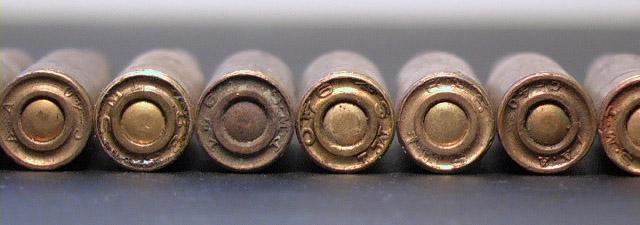
The SMI round, named after the letter marking 'SMI' found as the 'headstamp' on the cartridge base, was the conventional military round manufactured for the 6.5mm Italian Carcano rifles. While other rounds were manufactured elsewhere, this appears to be the dominant full metal jacketed round found in the United States. The rounds were made with corrosive primers and most do not detonate when struck with the firing pin. However, the bullets are usable if reloaded. I had purchased approximately 1000 rounds for experimental purposes.
Bullet Weight- I used a kinetic bullet puller to extract the old SMI bullets from their casings. The old bullet had grime and oxidation, so I cleaned them with a household degreaser, rinsed with water and brightened them with Brasso metal polish to restore them to a like-new condition. I weighed 24 bullets initially using an RCBS digital scale accurate to .1 grains. I then cleaned and polished 26 more to obtain a sample of 50 SMI bullets.
SMI mean weight- 160.87 grains
SMI range- 159.9-162.1 grains
SMI spread- 2.2 grains
SMI diameter- .266"
Base to opening- 1.326 mm
Base thickness- .312mm, or .0123"
Mid-body thickness- .343mm, or .0135"
Near-Nose thickness- .401mm, or .0158"
|
|
WCC vs. SMI- A Comparison of the Base and Cannelure
Base Comparison
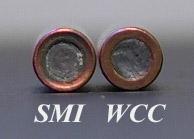
The base comparison shows the jacket thickness to be about the same. However, I have noticed that the SMI bases differ slightly. The jacket has an indented lip on the base in contrast to the WCC bullet's apparent flat jacket base. The opening of the SMI rounds does tend to differ from bullet to bullet. I do not have enough WCC rounds to make a similar comparison.
Cannelure Comparison
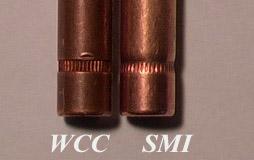
The cannelure's appear to be at the same distance from the base, however an obvious difference is noted. The superior and inferior margins of the WCC cannelure are clean and distinct, while almost all SMI cannelures are less so.
|