The Neck


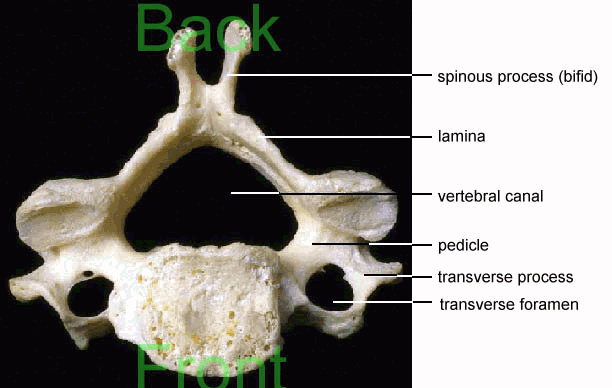
The cervical vertebrae are unique in their structure. They have two unique, identifying features. First, they have a 'bifid spinous process'. 'Bifid' means that the spinous process is divided into two 'clefts'. The second unique feature is the 'transverse foramen'. This is an opening in the 'transverse process' that allows passage of a small artery called the 'vertebral artery'. This artery is an ascending branch of the subclavian artery. It passes through the 'transverse foramen' at the sixth cervical vertebra, travels upwards across the posterior arch of the first cervical vertebra, enters the skull and joins the other vertebral artery, forming the 'basilar artery'.  
 
The most important feature to note is that the seventh cervical vertebra is transitional. It has features of both cervical and thoracic vertebra. It does NOT attach to a rib except in very rare instances where a 'cervical rib' may be present and does not have a 'bifid spinous process'.
The large central opening is the 'vertebral canal'. This is the opening in the vertebrae where the spinal cord transits from the brain to the lumbar spine. The spinal cord normally terminates at the L1-2 level. The remaining nerve tissue is referred to as the 'cauda equina', or horse's tail due to it's appearance.


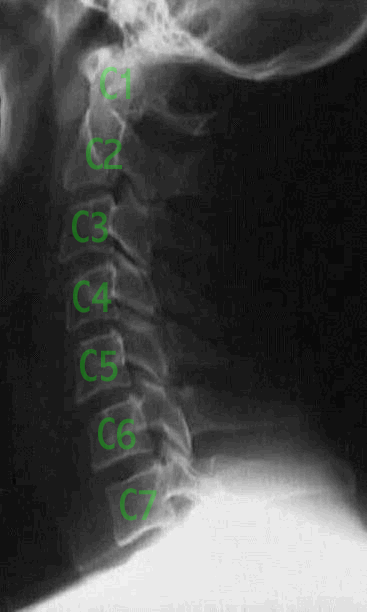
The illustration to the right is of a textbook normal cervical spine. It consists of seven cervical vertebrae and has the normal curve, or 'lordosis'. Lordosis is a medical term derived from the Greek 'lordos', meaning 'bent backwards'. In medical use, it means that the convexity is to the front. In other words, if you were to draw a line through the center of the vertebra starting at C1 and going to C4, as well as a line from C7 to C4, they would converge at a point towards the front in reference to the starting points- C1 and C7. A lordosis, in lay terms, is a curve towards the front.  
 
The darker areas between the vertebrae contain 'discs'. These discs are composed of an outer layer of cartilage, the 'annulus fibrosis', and an inner gel-like substance, called the 'nucleus pulposis'. The discs separate the vertebrae and allow for freedom of motion to exist in the spine. In addition, they act like spongy shock absorbers to reduce the stress of the head on the neck.  
 
Together, the disc and the lordotic curve allow for freedom of motion while reducing the overall stress to the joints of the cervical spine. This is true in all areas of the spine. However, the thoracic area has the opposite type of curve, called a 'kyphosis'. The lumbar spine has a lordosis. The sacrum, made of fused vertebral segments, has a kyphotic shape. Alterations from normal occur regularly due to birth defects, trauma and/or degeneration. 
 
(The author is unaware of any published material pertaining to President Kennedy's neck that would suggest that it had ANY abnormal characteristics)