|
|
CE 543: Quite Possibly the Most Understood Dent
Chad R. Zimmerman © Copyright 2003. All rights reserved.
|
|
|
|
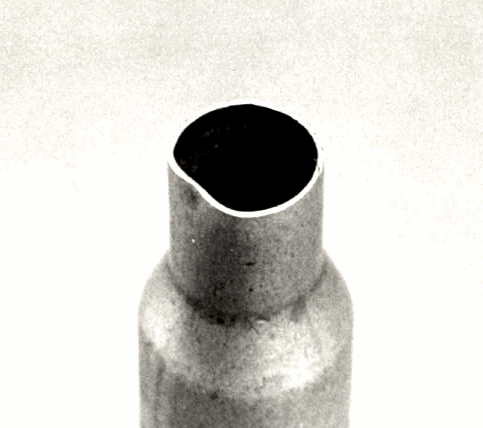
In the eyes of many conspiracy enthusiasts, this image of CE 543 (Commission Exhibit 543) is obvious proof of a conspiracy in the assassination of President John F. Kennedy. The theory is simple and easily believed. Basically, if the lipping of a shell casing is dented, it cannot fit into the receiving chamber of the gun and therefore cannot be shot. Since most witnesses in Dealey Plaza recall 3 shots, and only 3 shell casings were found in the Texas School Book Depository, this shell is not only suggestive...but is absolute proof that a conspiracy existed. If this casing could not fit in the receiver, then Oswald or whomever could only have fired 2 shots. Another shot or two rang out from another location. Conspiracy. Simple right? Wrong.
|
|
Simple Truths About Rifle Shells
A live rifle shell, or cartridge, is a very simple device. It consists, usually, of a brass casing such as the one above. The casing has a primer attached to the base that provides the ignition to the explosive gunpowder within the casing. The bullet is 'seated' in the case and the case is crimped, or tightened, around the bullet. The firing pin of the rifle impacts the primer. The primer fires due to the compression created from the firing pin 'punching' the metal base of the primer. This ignites the powder and creates a very fast expansion of gases. That expansion is powerful enough to push the 'seated' bullet from the casing. The bullet continues to be pushed as the gases expand, developing velocity over the length of the rifle barrel. This is a very, very simple concept.
Now, CE 543 was originally a live 6.5mm Western Cartridge Company round. The bullet was a typical, military full metal jacketed round. The jacket consisted of a copper alloy on the outside. The inside was filled with lead and a small opening was at the base. The strong copper jacket requires a significant force to deform the casing. A lot of conspiracy theorists believe that the dent was caused by the gun jamming while Oswald, or some other unnamed assassin, tried to load the shell from the clip to the receiver. However, if that had occurred, the bullet itself would have to deform to allow for the crimped brass casing to dent. Since the bullet was hard jacketed and filled with lead, the likelihood of such and event occurring is almost zero. The likely scenario is that the casing was dented after firing during the ejection of the casing. This is NOT uncommon with bolt action rifles. So, I decided to investigate and experiment further.
|
|
The Simple Experiment
The first time I ever took my Carcano out to sight it in, I noticed that at least one of the shell casings was significantly dented at the lip. I had hand fed most of the rounds one by one and ejected the shells by hand. A few times I performed a regular 'hard ejection' by pulling the bolt back and ejecting the shell. Intuitively, I felt that this was the mechanism that created the dent. So, I took the rifle home to do some tests with empty casings. I took some of the undented casings and loaded and ejected them, one by one. During one particular ejection, I felt as though something (the casing) had actually hit the gun, but it happens so fast that you cannot really notice it. So, I loaded a undented casing and slowly ejected the shell and watched it. Just as I had thought, it hit the gun. It was much simpler of a mechanism than I had thought.
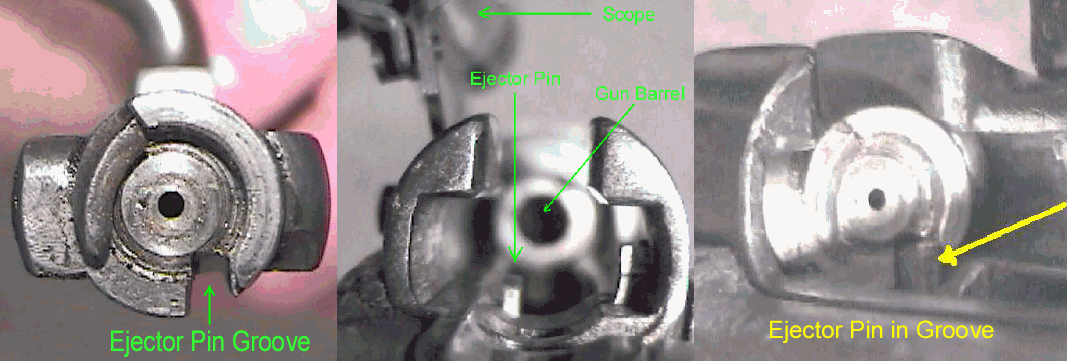
The casing is ejected when the bolt is retracted, or pulled back. The bolt 'track' on the gun has a small metal 'pin' that sticks up and fits in a small, linear groove on the underside of the bolt. As looking down the gun as with aiming, the pin is on the left side of the bolt track. The bottom left edge of the casing comes into contact with the 'ejector pin' as the bolt is pulled back. This causes the shell casing to flip out to the right. This is the reason why Oswald's rifle scope was mounted on the left side of the gun (See picture). Now, since the bolt is being retracted with a fairly high velocity, the casing is moving backwards at a fairly high rate of speed when in contacts the ejector pin. The result is that the casing flips to the right, while retaining much of the rearward velocity. As it flips, it hits what is referred to as the 'bolt brake'. This is a piece of metal that keeps the bolt from being fully extracted when ejecting shells. It is really part of the entire bolt track and helps keep the bolt guided. When the shell casing hits the bolt brake, it dents the lip. That is the part that most commonly hits the bolt brake. See below.
|
|
|
See the ejection sequence below.
|
|
|
|
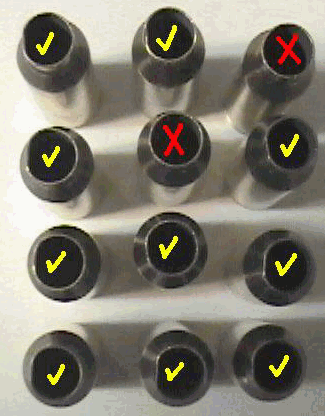
I decided to see if this occurred on a fairly regular basis. I took 12 empty, undented casings and loaded and ejected each of them one time. I collected the casings. To my surprise, 10 out of 12 casings were dented to some degree. Some had very minor dents, others had more severe dents. Cold cases do not dent as readily as hot, recently fired casings. It also depends on how fast the shell is ejected. See picture below.
|
|
|
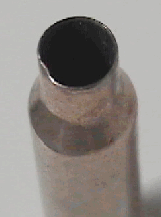
As you can see, the process of denting a shell casing is not as mysterious as once thought. For some reason, many conspiracy believers apparently don't test their assumptions. I have heard stories of individuals throwing live shells against the wall to try and get them to dent the same as CE543. However, it is an UNloaded shell that is dented, not a loaded one. And, it done so by a means that is EASILY reproducible. Buy a gun and try it out for yourself. Here is a picture of one shell casing that I dented after firing and ejecting it from the gun.
|
|