|
|
Sherry's Illustration
|
|
|
|
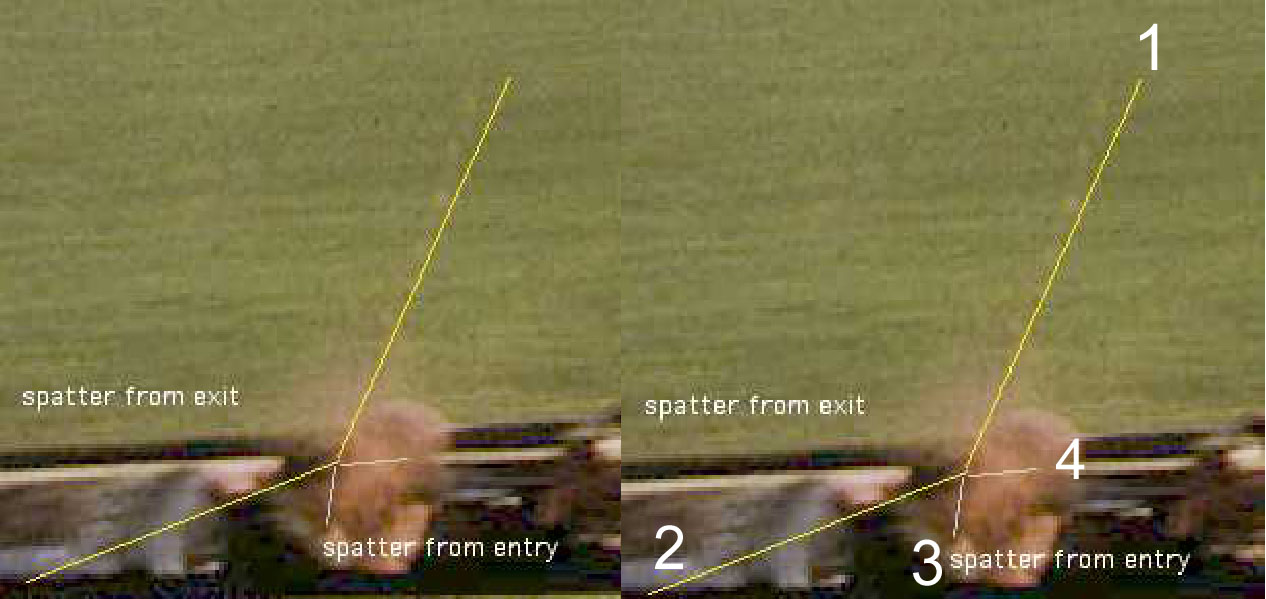
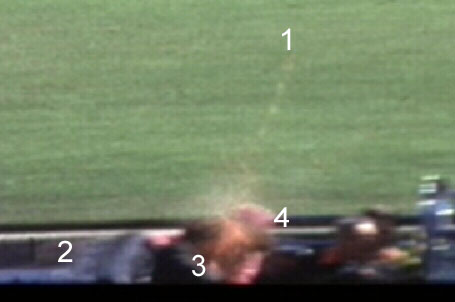
In the above illustration, you will see Sherry's defined entry and exit cones. I have taken the liberty to label the lines with numbers for easy reference. Line 1 correlates to the 'white streak'. Line 2 is the second border of the exit cone. Lines 3 and 4 are defined from a 'triangle' formed from the extrusion of tissue and blood just above and in front of Kennedy's right ear, where the 'flap' of bone is located. Below is a different version of frame 313 captured from DVD. It is labeled with the numbers in about the same place, but without lines drawn in.
|
|
The Zapruder Film
|
|
|
In my opinion, this frame is a little clearer than the picture posted at the JFK Lancer site. As you can see in this picture, the line that corresponds to number 2 does not have an obvious streak creating the second part of the exit cone. In fact, other than the small 'cloud' of debris extending above and slightly behind the 'white streak' of line 1 for a short distance, there isn't any significant debris behind the President. This is the alleged 'mystery debris' that Sherry says, "Although the exit spatter is not visible, it did exist". The proof? The follow up car and Hargis were hit with it. That's it. Blood Spatter Analysts analyze blood. But, in this case, they analyze the testimony regarding blood. It's somewhat anecdotal evidence. But, no doubt it did happen...it's just not in the film. It had to have happened very, very fast to not be seen in the Zapruder film. Now, let's take a look at frame 314.
|
|
|
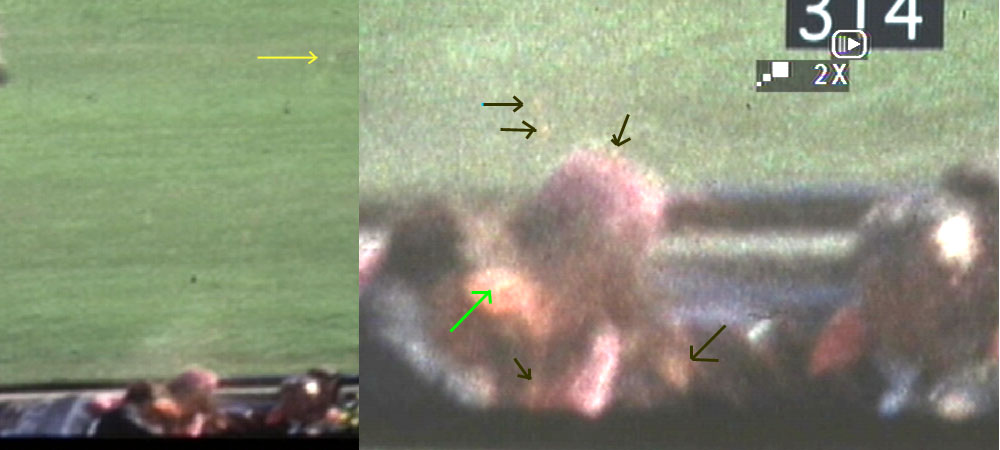
Frame 314 is very interesting. Again, we see nothing much to the rear of President Kennedy. The yellow arrow is likely a considerable fragment of bone that is visualized in frame 313 as the top of the 'white streak'. In this frame, we see the emergence of the 'bone flap' (green arrow) that creates the margin of Guiterrez's entry cone. The other black arrows illustrate pieces of debris that are 'in transit'. Most debris is seen in front of Kennedy. But, since the spatter went in "all directions" this is easily explained as forward or back spatter. It's speed is slow, making it consistent with back spatter. And, since forward spatter may have high velocity debris, there is also slow velocity debris. It could be either.
|
|
|
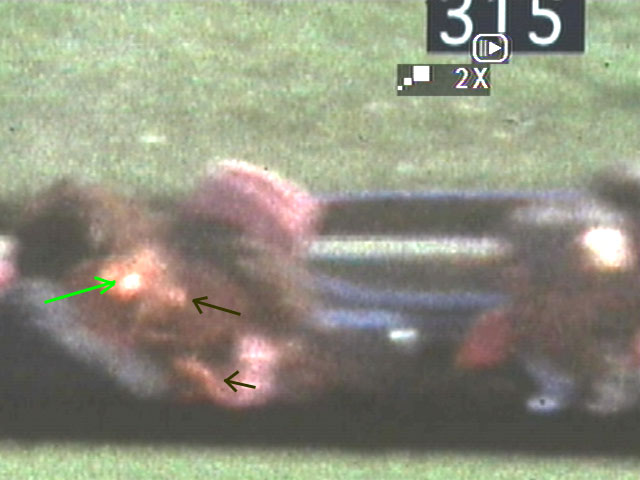
Frame 315 shows more of the same debris highlighted with the black arrows. The bone flap emerges and is reflecting light towards Zapruder's lens. More debris is seen in front of Kennedy. As we concluded before, nothing is seen behind Kennedy. In the next frame, frame 316, we are given a very clear view of the debris in front of Kennedy. Frame 316 is one of the clearest frames.
|
|
|
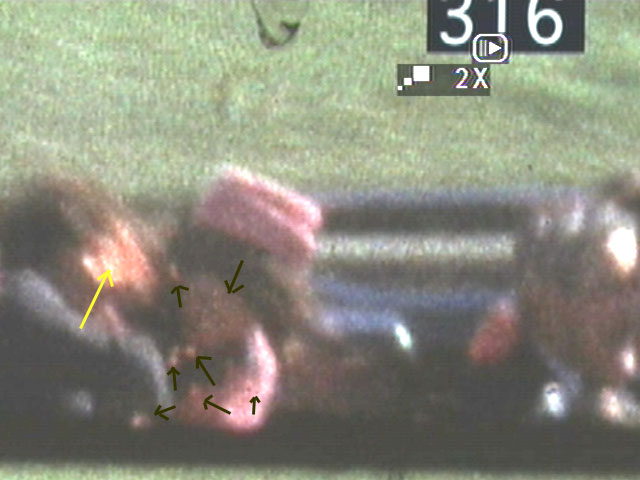
Frame 316, captured from DVD, shows fairly good sized chunks of brain tissue (most likely). These are easily seen and some are highlighted with the black arrows. Now, you have to ask a very important question. Exactly how much of the 'entry cone' is defined by margins created by the bone 'flap', highlighted in yellow? Is the entry cone a true spatter cone, or a cone created by the bone flap?
|
|
The Mystical Mist
|
|
It is quite obvious from Sherry Guiterrez's reply that she does not believe in the 'mist hypothesis'. However, something hit the followup car and Hargis. We know that there wasn't enough blood in Kennedy's head to form a "bucket of blood", but there was enough to create a large spray of mist. As Sherry Guiterrez has pointed out, the ejecta went in "all directions". Is this not also true of very fine droplets of blood? Tiny droplets, like those sprayed out of a spray bottle, do not weigh much at all. The went up in the air and formed a 'halo' of mist that is seen in the Zapruder film, the Nix film and the Muchmore film. But don't take my word for it. It's seen right here.
|
|
The Mysterious U.F.O. (This is not Unidentified Flying Occiput folks)
|
|
As much as I would like to take credit for this find, I cannot. Perceptual researchers Paul Seaton and Steve Barber noticed something in the MPI digital remake of the Zapruder film that stunned them, and myself. It appears, to me at least, that what is visualized is a fragment of bone ejected from the front, parietal area of Kennedy's head. It can be seen emerging from the wound in frame 313 as the right side of Guiterrez's entry cone. It is seen in flight in frame 314. When Zapruder filmed the assassination, the camera panned upwards a tiny bit, taking the lower margin of the top of the car out of the frame. Because of this, you cannot see into the car for a few frames, then he lowered the camera again. What was captured is both gross and amazing. Click here to see the video sequence. I highlighted the bone fragment in the video. It actually appears about 2 frames before my highlights of the bone appear. I did not notice that until I had completed the video editing. Watch closely. Roses are Red, Violets are Blue. Roses don't bounce and tumble, but parietal bones do!
|
|
The Second 'Streak'
|
|
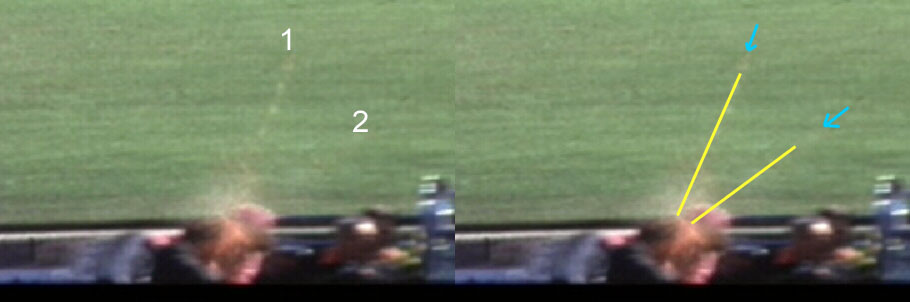
Frame 313 shows one obvious streak of debris emanating from the top right of Kennedy's head and was illustrated above. However, clear copies of the Zapruder film also show another fast streak below that one. This is outside of her exit cone. Maybe the exit cone is bigger than even she imagined.
|
|
|
Frame 313 is not extremely clear. There is a lot of fast moving debris and the panning of the camera creates a little blur. But, when seen in motion, there are two streaks of ejected debris. Not one. When you watch the negative enhancement, it becomes clearer. It is a very fast streak that is only seen in frame 313 because it either rapidly dissipates by 314 or is out of frame. Watch the negative enhancement here. You need to watch closely.
|
|
Now, if you haven't already, please check out my other page entitled "Where was that Head Wound? Just the Facts Ma'am."
That article will describe some of the other aspects of President Kennedy's head wound. He sure had an awful big hole above his ear caused by an alleged frontal shooter firing from the front right. For some odd reason, all the large, non-miniscule debris seemed to go in a forward direction. So, how does a shot from the front pull that trick off. It must be because none of it was captured in the Zapruder film because it was too fast. Sorry, I forgot.
|
|
A Sample Trajectory
|
|
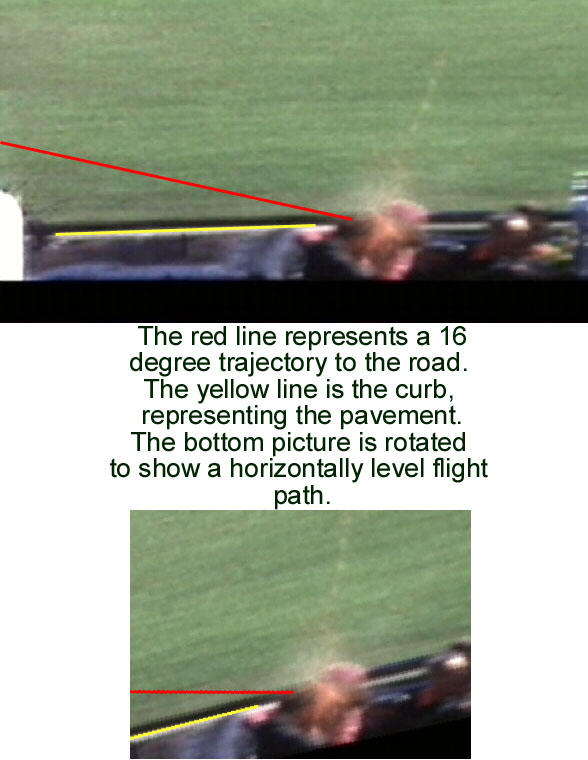
Now, a lot of the general experiments that have been performed for the utilization and creation of the laws regarding the dynamics of blood are performed on horizontal trajectories. Not all are, but most are. That is, the bullet is fired perpendicularly to the target. In the case of Kennedy, a rear, elevated shot cannot be excluded. So, let's look at an example. Let's pretend that Kennedy is being fired at from a horizontally perpendicular location. We can do this by rotating the picture. Here you go.
|
|
|
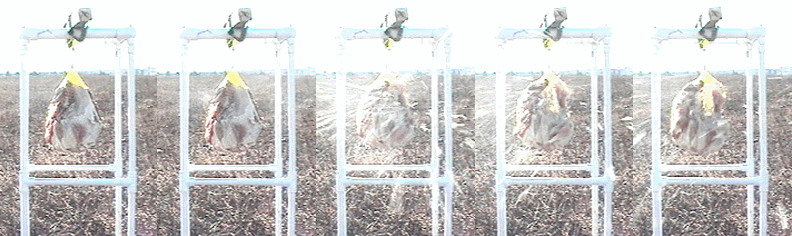
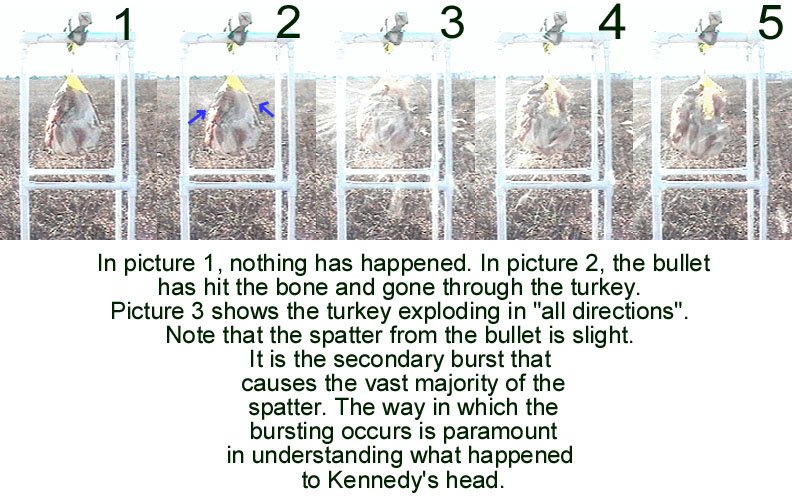
Now, you must first understand what happens when bullets strike and cause pressure cavities and subsequent explosions. First, the bullet goes completely through, creating a small amount of back spatter, and a larger amount of forward spatter. We will use examples from a turkey breast that I attached rib bone to the front of to illustrate what the eyes cannot see.
|
|
|
Now, let me explain what is happening here. You may choose to view the video of this by clicking here. Then scroll down to view the clip. What we see is this:
|
|
|
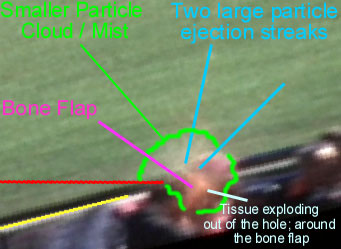
So, the bursting of the skull in frame 313 is not quite as pretty as a picture of a bullet through an apple. Other things have taken place. The bullet has already entered and left Kennedy's head. This impact and transit causes a pressure cavity in the soft tissue of the skull. Since the skull was severely fragmented, the pressure was released through the areas of lease resistance. You see the top right of Kennedy's head explode. Does that mean that's exactly where the bullet came out or went in. No. It is the pathway of least resistance caused by the fragmentation of the skull...caused by the bullet. It's not as simple as you may think. What Sherry Guiterrez is looking at in 313 is NOT the same as the picture of a bullet going through an apple. The little bursts of blood from the entrance and exit of the bullet are not seen. You see the explosion of the pressure cavity through the areas of least resistance. Unfortunately, this was not in the back of the head. Also, please note the multidirectional capability of the exploded tissue above. It went everywhere, including quite a bit on the camera itself. The bullet traveled from left to right in the above picture sequence. See below for an alternate explanation/illustration.
|
|
|
By the time this took place, the neat little pockets representative of the entrance and exit, such as seen in the picture of the bullet through an apple, were gone. All you have left is the secondary explosion, which obliterates any chance of seeing nice, neat entrance and exit patterns.
|